TRIATHLON COURSE AND WEATHER ADJUSTMENT CALCULATOR: YOUR FLAT-COURSE TIME MEETS THE ACTUAL COURSE

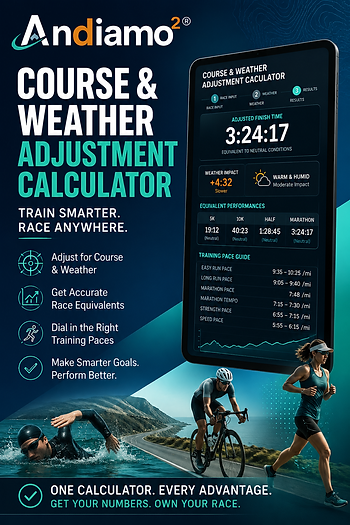
Picture two numbers side by side. One is your predicted finish time on a flat course in perfect weather. The other is what that same fitness actually produces on the course you're racing — 3,500 feet of climbing, 88 degrees by early afternoon with 40% humidity. The first number is clean and useful for comparing yourself to other athletes. The second number is the one that decides whether your pacing plan survives contact with the day.
Most finish time predictions never bother closing that gap. They can't — a flat, neutral baseline is the only way to give every athlete a fair, comparable starting point. But a baseline was never meant to be a forecast and treating it like one is exactly where race-day disappointment tends to come from. Use the Triathlon Course and Weather Adjustment Calculator to adjust your flat-course finish time for real elevation and heat — physics-based climbing model plus an honest heat-range estimate.
TWO KINDS OF MATH, TREATED DIFFERENTLY
Start with your baseline bike and run splits — ideally the flat, neutral-weather numbers straight from the Race Finish Time and Goal Feasibility Predictor. From there, the tool runs two adjustments that work nothing alike, and it says so plainly rather than blending them into one falsely confident number.
The elevation side is pure physics. Your bike split gets converted into an implied steady wattage based on the position you rode when you recorded that baseline — hoods, clip-on aerobars, full tri tuck — and that wattage gets applied to your actual course's climbing and descending, in whatever position you'll race. Switch from a road bike to full aero for race day, and that shows up as a real speed change even on flat ground, exactly like it would on the road.
Your run split gets adjusted using the Minetti research on the metabolic cost of running on a grade — the same science behind Strava's Grade Adjusted Pace — and descending doesn't hand back the full-time gravity seems to promise either, since braking forces are real and the model discounts downhill benefit accordingly.
The weather side is honest about its own uncertainty. Using your expected temperature and humidity, the tool estimates Wet Bulb Globe Temperature and applies a slowdown curve from marathon heat research. But heat tolerance varies enormously between individuals, so instead of one confident number, you get a range — low, central, high — because a single precise figure here would be a worse kind of dishonesty than showing the spread.
WHAT COMES BACK, AND WHICH PART TO TRUST MORE
Your adjusted finish time shows with a range when heat is a real factor, and a breakdown table shows exactly where every minute comes from: baseline, position change, elevation, heat, tracked separately for bike and run.
Rows carry either a "modeled" tag or an "estimated range" tag, and that distinction matters more than the headline number itself. Gravity and aerodynamic drag don't have off days — plan around the elevation and position rows with real confidence. Heat tolerance does vary day to day and athlete to athlete — treat those rows as a planning midpoint and a patience reminder for the slow end, not a guarantee.
If your forecast lands in hot or very hot territory, the results prompt a direct coach conversation. That's the exact point where error bars widen and pacing strategy starts mattering more than anything a calculator alone can responsibly settle.
WHERE THIS FITS INTO YOUR PREP
Run the Race Finish Time and Goal Feasibility Predictor first for your flat-course baseline — that's the number this tool asks you to start from.
Once your adjusted, real-conditions splits exist, the Cutoff Time Checker is worth a second look: a finish time that looked comfortable against official cutoffs on paper can read very differently once climbing and heat are actually in the math.
And if your adjusted numbers shift your race duration meaningfully, bring the new time back to the Triathlon Fueling Calculator, since your carbohydrate and fluid targets are built around how long you'll actually be out there.
An adjusted finish time that's meaningfully slower than your flat-course baseline isn't a fitness problem in the usual sense — it's information about your specific course, and it belongs in how you prepare for it. A hilly bike course rewards dedicated climbing work. A hot-weather race rewards heat-acclimation sessions built deliberately into the build, not improvised race week.
The Training Plan Selector matches you to an Andiamo²® plan for your distance and athlete category, and once you know what your course and conditions actually demand, that's worth bringing straight into a conversation with a coach.
A FEW THINGS PEOPLE ASK
Why does the tool ask for bike position twice — once for the baseline, once for race day?
Because the position you rode when you recorded your baseline is what the tool uses to work out your real wattage in the first place. Racing in a different position than your baseline — hoods to clip-on aerobars, say — is a genuine aerodynamic change it can account for, even on flat ground. Same position both times, no aero adjustment applies.
Why does heat get a range while elevation gets one clean number? Because they're fundamentally different calculations. Elevation and aerodynamics follow physics that applies identically to every rider and runner. Heat tolerance genuinely varies by acclimatization, fitness, and physiology — a single confident number there would be false precision dressed up as accuracy.
My adjusted time came out much slower than expected — does that mean my goal is unrealistic? Not necessarily. It means your flat-course baseline was never going to hold up against real climbing or real heat, and now you know by roughly how much. Use the adjusted number for cutoffs and fueling, not the flat one. A large gap is useful information for where to focus training over the next several months — not a verdict on race day itself.
Your flat-course prediction was never wrong. It just wasn't built to answer the question you actually need answered how much both the course and the weather change impacts how you'll actually preform on race day.
Want a coach to look at your specific course and forecast? Reach out here.
Just getting into structured training? The Splash Class shown below is a free 12-week swim and strength plan built to test-drive Andiamo²® structure first. Just drop your email and we'll send the access code direct to your inbox.
Thanks for reading!
Andiamo²®
Follow on Facebook!


