The Senior Triathlete’s Advantage: Why a Smarter 36-Week Full Distance Training Plan Build Beats “Hero Training” at 60+

Updated: Sep 9
There’s a quiet shift that happens after 60.
You stop chasing workouts that look impressive and start valuing training that actually works.
For self-coached senior triathletes, the biggest challenge is rarely motivation. It’s uncertainty:
Am I training hard enough?
Am I recovering enough?
How do I improve without breaking down?
Why do so many Ironman plans feel built for 35-year-olds with unlimited recovery?
The answer isn’t more toughness.
It’s better structure.
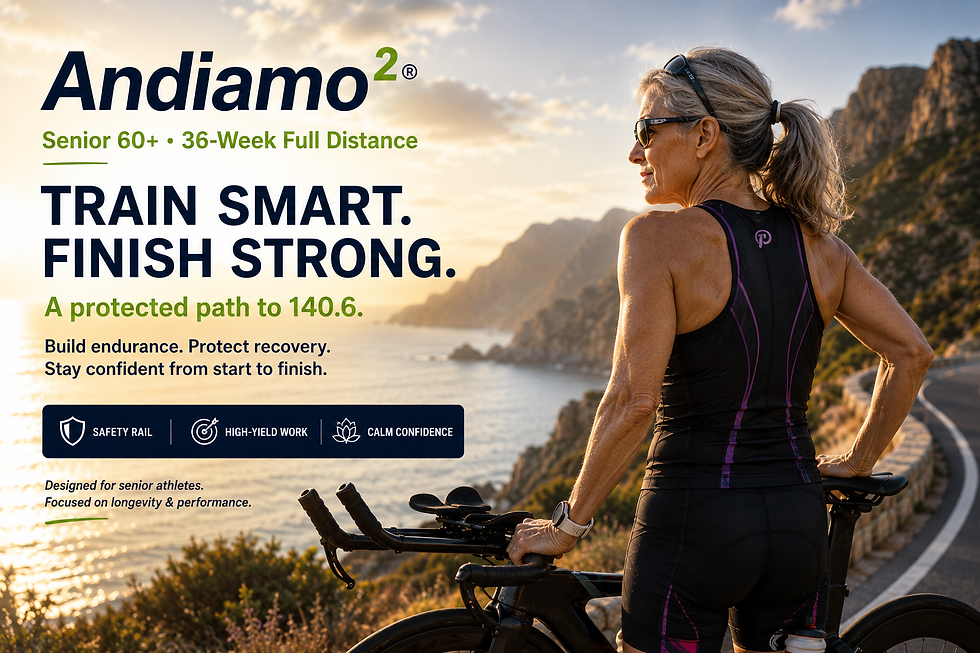
The Andiamo²® 36-Week Full-Distance Plan for senior triathletes 60+ was built around one core idea:
Your advantage at 60+ is not pain tolerance. Your advantage is consistency.
And consistency only happens when your training system protects recovery as aggressively as it builds fitness.
Why Most Full-Distance Plans Fail Senior Athletes
Many traditional Ironman plans quietly assume:
unlimited recovery capacity
high weekly volume tolerance
aggressive progression
“more is better” training philosophy
That approach often creates a dangerous cycle for senior athletes:
Train hard → accumulate fatigue → lose confidence → miss sessions → restart
emotionally exhausted.
The problem isn’t effort.
The problem is recovery debt.
At 60+, fitness can still improve dramatically — but adaptation requires precision.
That’s why this 36-week system is intentionally built with:
longer runway progression
controlled intensity
recovery protection
minimum-effective-dose philosophy
high-yield sessions instead of junk mileage
The goal is not survival training.
The goal is sustainable adaptation.
The Real Goal Isn’t “Doing More”
A common fear among self-coached senior triathletes is:
“If I reduce volume, won’t my performance suffer?”
Not necessarily.
In fact, many older athletes improve when unnecessary fatigue is removed.
The Andiamo²® approach focuses on Training ROI:
every workout has a clear purpose
pacing stays controlled
fatigue stays measurable
recovery becomes part of the strategy
This is where many athletes discover something unexpected:
Fewer hours can produce better outcomes when the work is cleaner.
Instead of constantly proving fitness through exhaustion, the system teaches your body to:
absorb training
recover predictably
maintain durability
stay emotionally calm across long preparation cycles
That calmness matters more than most athletes realize.
Why 36 Weeks Works Better for Triathletes 60+
Many senior athletes worry that a 36-week build sounds “too long.”
Usually, it’s exactly the opposite.
A longer runway allows:
aerobic fitness to develop gradually
connective tissue to adapt safely
recovery to remain intact
confidence to compound over time
Fast progress often becomes fast fatigue.
Longer progression creates stable fitness.
This plan uses two distinct phases:
Phase 1: 12-Week Aerobic Foundation
The first block develops:
aerobic conditioning
swim efficiency
movement economy
neuromuscular coordination
foundational VO₂ support
This phase matters because senior athletes often don’t fail from lack of motivation.
They fail from stacking intensity onto an unstable aerobic base.
Phase 2: 24-Week Race-Specific Build
Once the foundation is stable, training shifts toward:
long rides
tempo endurance
open-water preparation
threshold durability
sustainable race pacing
The key difference: the build progresses without turning every week into a survival contest.
Because Ironman success at 60+ rarely comes from one epic workout.
It comes from executing many clean weeks in a row.
The 2:1 Recovery Rhythm That Keeps Senior Athletes Moving Forward
One of the smartest features of this plan is the 2:1 structure:
2 focused build weeks
1 absorption/recovery week
Many athletes resist recovery because they fear losing fitness.
But physiologically, recovery is where fitness actually becomes usable.
Without recovery:
fatigue rises
pacing drifts
injuries accumulate
motivation collapses
With recovery:
adaptations stabilize
joints calm down
confidence stays intact
consistency continues
For self-coached athletes, recovery weeks are not “easy weeks.”
They are insurance policies against breakdown.
Why Metrics Matter More at 60+
One of the biggest mistakes self-coached triathletes make is training emotionally instead of objectively.
The Andiamo²® system uses:
MHR (Maximum Heart Rate)
FTP (Functional Threshold Power)
RPE (Rate of Perceived Exertion)
These guardrails reduce accidental overtraining.
Because “accidentally hard” training is one of the fastest ways to sabotage senior consistency.
The goal is not constant depletion.
The goal is purposeful effort.
A simple rule:
Most workouts should end with you feeling capable, not destroyed.
That’s how sustainable progress is built.
Senior-Specific Strength Training Is Not Optional
Strength training after 60 isn’t about aesthetics.
It’s about preserving:
posture
bone density
joint resilience
movement durability
long-term function
This plan includes structured resistance work specifically designed to support endurance training — not interfere with it.
Done correctly, strength becomes:
protective
stabilizing
repeatable
Not punishing.
The Quiet Superpower of Senior Triathletes
Younger athletes often win short-term training battles through aggression.
Senior athletes win differently.
They win through:
pacing discipline
emotional control
patience
strategic recovery
consistency
That’s why the best senior training systems don’t create adrenaline.
They create confidence.
And confidence changes everything:
better execution
less anxiety
cleaner race pacing
more durable fitness
fewer emotional swings
The Best Full-Distance Plan for Self-Coached Athletes Over 60?
The best plan is not the hardest one.
It’s the one you can execute calmly for 36 weeks without constantly needing to “prove” yourself through extra miles.
Because at 60+, the real competitive edge is not suffering more.
It’s adapting better.
And adaptation comes from:
smart structure
protected recovery
precise intensity
repeatable execution
Not chaos.
Final Thought: Calm Training Creates Stronger Racing
Triathlon is already difficult.
Your training system should reduce uncertainty — not amplify it.
A great senior Ironman plan acts like a guardrail:
guiding effort
protecting recovery
removing guesswork
preserving confidence
That’s how athletes stay competitive deep into their 60s and beyond.
Not by training harder than everyone else.
By training cleaner than everyone else.
Ready to Race Smarter?
Our senior triathlete training plans don't just build fitness
— they build the habits and
structure that hold up when it matters most.
Questions or need help choosing a plan?
Share a few details and an Andiamo²® coach will help you choose the right structure for the athlete you are today.
Follow us on Facebook!
Thanks for reading!

