Hanson-Style Marathon Training: Why Smarter Runners Don't Rely on Longer Long Runs


Training for a marathon has traditionally followed one philosophy:
Run longer.
Many marathon plans build around increasingly longer weekend runs, often peaking at 20–22 miles. While this approach has helped thousands of runners reach the finish line, it's not the only way to prepare for 26.2 miles.
The Hanson-style approach takes a different path.
The Hanson-style approach takes a different path.
Instead of placing most of the training emphasis on one weekly long run, it builds fitness through consistent weekly mileage, cumulative fatigue, and purpose-driven workouts. The result is a training system that teaches your body to run efficiently when you're already tired—exactly what happens during the final miles of a marathon. The calculator on this page follows those same Hanson-inspired principles to estimate race predictions and personalized training paces.
What Is Hanson-Style Marathon Training?
Hanson-style marathon training is based on a simple principle:
Your marathon fitness comes from the total workload across the week—not from one exceptionally long run.
Rather than treating the long run as the single most important workout, the program combines several key elements that work together:
Frequent aerobic running
Marathon pace workouts
Threshold (strength) sessions
VO₂ max intervals
Consistent easy mileage
By race day, your body has accumulated weeks of controlled fatigue, preparing you for the demands of the final 10K when the marathon truly begins.
The Six Principles Behind Hanson-Style Training
1. Cumulative Fatigue
Fitness develops from the combination of every workout throughout the week.
Instead of recovering completely before each long run, runners learn to perform quality workouts while carrying manageable fatigue—closely simulating marathon conditions.
2. The 16-Mile Long Run
One of the biggest surprises for runners new to the Hanson approach is the long-run cap.
Unlike traditional plans that often reach 20 miles or more, Hanson-style training typically limits long runs to around 16 miles.
The goal isn't to avoid distance.
The goal is to avoid unnecessary recovery that can interfere with the rest of your training week.
3. Marathon Pace Training
Running your goal marathon pace regularly teaches your body exactly what race-day effort should feel like.
These workouts improve pacing confidence, efficiency, and fuel utilization while reducing the temptation to start too fast on race day.
4. Strength (Tempo) Workouts
Threshold workouts—often called strength sessions—develop your ability to sustain faster efforts while delaying fatigue.
They raise your lactate threshold, allowing marathon pace to feel more comfortable over time.
5. Speed Development
Intervals performed at approximately 5K–10K effort improve VO₂ max, running economy, and aerobic capacity.
These sessions increase your fitness ceiling, making marathon pace more sustainable.
6. Truly Easy Running
Many runners unintentionally run their easy days too fast.
Easy runs exist for recovery, aerobic development, and preparing your body for the next quality workout.
Keeping easy days easy is one of the most overlooked keys to consistent improvement.
Why Personalized Training Paces Matter
One of the biggest mistakes runners make is using generic pace charts.
A pace that's appropriate for one athlete may be completely wrong for another.
The Hanson-Style Marathon Training Calculator solves this by using your recent race performance to calculate personalized training paces.
Instead of guessing, you'll receive recommended paces for:
Easy Runs
Long Runs
Marathon Pace Runs
Threshold (Strength) Runs
Speed Workouts
Every workout has a specific purpose.
Race Day Isn't Always Perfect
Most online pace calculators assume ideal conditions.
Real races rarely happen under ideal conditions.
That's why the Hanson-Style Marathon Training Calculator also considers environmental factors such as:
Temperature
Humidity
Wind
These conditions can significantly affect pacing and predicted finishing times, helping you create a more realistic race strategy.
Predict Future Race Performances
Curious what your recent 10K suggests for a marathon?
Wondering how a half marathon translates into a full marathon prediction?
The calculator estimates equivalent race performances across multiple distances, giving you a realistic starting point for goal setting and training progression.
Is Hanson-Style Training Right for Triathletes?
Absolutely.
The emphasis on cumulative fatigue fits naturally with triathlon training.
Because swimming and cycling already contribute substantial training stress, avoiding excessively long runs often allows triathletes to:
Recover better
Maintain bike quality
Continue swim development
Reduce injury risk
Build consistent run fitness
For athletes preparing for long-course triathlon, this balanced approach can integrate more effectively than marathon plans centered around very long runs.
HOW YOUR RESULTS POINT TO THE RIGHT TRAINING PLAN
Five paces and a weekly template show you what a Hanson-style week looks like in outline. They don't replace the multi-month periodization — when speed work intensifies, when your peak mileage actually lands, how the whole build tapers into race week — that a full training plan is built to handle, especially for a first-time marathoner or a triathlete trying to fit this structure around swim and bike sessions in the same week.
The Training Plan Selector matches you to an Andiamo²® plan for your goal, built around this same cumulative-load thinking but sequenced properly across your entire build, not just laid out as a single representative week.
HOW THIS CALCULATOR CONNECTS TO THE OTHERS
If you're a triathlete, run this calculator using your best recent half marathon time for a half-distance triathlon build, or a marathon goal time for full-distance work — the capped long run and frequency-over-volume approach fits naturally around swim and bike sessions in a way that a traditional, single-massive-long-run marathon plan usually doesn't.
For a broader look at your run fitness specifically, the VDOT Running Calculator and the FTP Running Calculator both build training zones from tested or raced numbers using different methods — worth comparing against what this tool gives you, particularly if your marathon-pace number here doesn't match what those tools suggest for your threshold.
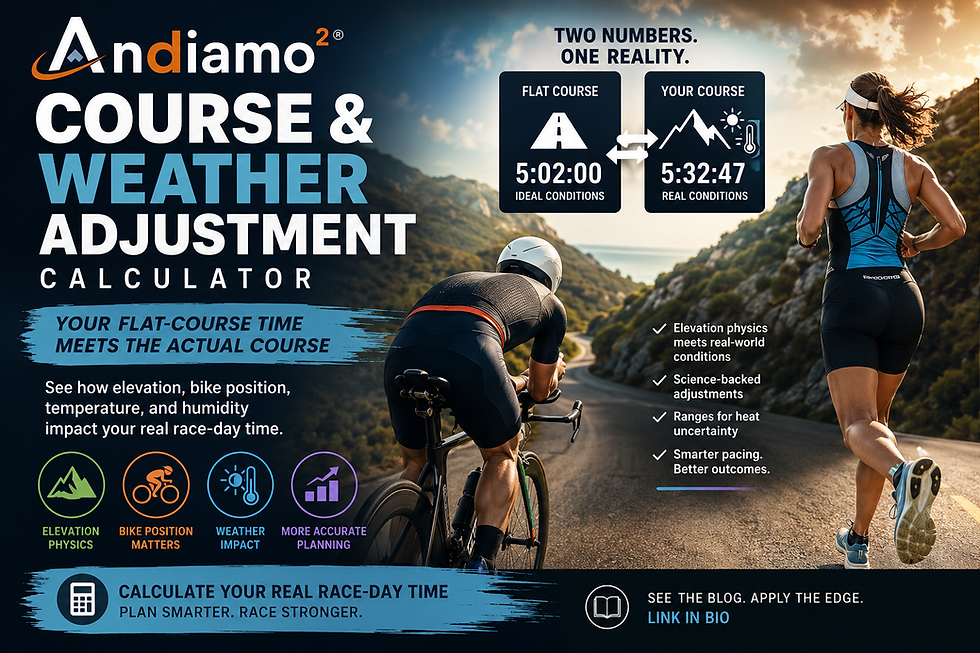
And once your race-day conditions are a real factor, not just a training input, the Course and Weather Adjustment Calculator applies similar heat and wind logic specifically to your actual race course rather than a generic forecast slider.
FREQUENTLY ASKED QUESTIONS
Why cap the long run at sixteen miles when the race itself is 26.2?
Because the sixteen-mile cap isn't meant to simulate covering the full distance — it's meant to simulate running well on legs that are already tired from the rest of the week. A fresh twenty-mile long run teaches you to run twenty miles when you're fresh, which isn't the situation you'll actually be in during the back half of your marathon. Sixteen miles on accumulated fatigue is a more honest rehearsal of what miles seventeen through twenty-six actually feel like.
Is this appropriate for a first-time marathoner?
Yes, with one real prerequisite: you need an existing base before starting, since peak weeks in this style of training reach thirty to thirty-five-plus miles. If you're currently running under twenty miles a week, build that foundation first. For runners who already train consistently, this structure carries less acute injury risk than a traditional plan built around occasional very long runs, since the capped long run keeps any single session from becoming disproportionately punishing.
How much should I actually trust the weather adjustment?
Treat it as a reasonable, research-grounded estimate rather than an exact prediction. Heat and humidity slow performance in a well-documented way, and the calculator's adjustment reflects that relationship, but individual heat tolerance varies. On a genuinely hot day, lean toward slowing down more than the tool suggests rather than less — the cost of being too conservative on a hot day is minor, and the cost of not being conservative enough isn't.
Should I follow these exact paces every week without adjusting?
No. These are calibrated starting points, not fixed instructions. Accumulated fatigue, hills, sleep quality, and how the rest of your training is going should all shift your actual effort on a given day, and recalculating every four to six weeks keeps your zones current as your fitness changes. The numbers are a reasonable default; your body's actual response during training is the better source of truth week to week
STOP CHASING MILEAGE AND START TRAINING THE RIGHT FATIGUE
A long run that leaves you flattened for a week and a half isn't building fitness — it's borrowing from every session that comes after it. Run your numbers through the Hanson-Style Marathon Calculator and train the kind of tired legs your race day will actually hand you.
Numbers raise questions — that's normal. Our coaches are here to help you make sense of them. We're listening.
Not sure Andiamo²® is the right fit yet? Leave your email below and we'll send your access code right away. Try the Splash Class first — 12 weeks free, no commitment required.
Thanks for reading!
Andiamo²®
Follow on FaceBook!